• Home
  • Best Bases
  • Recipes
  • Inspirations
  • Savings
    • Printable Coupons
    • Commissary Rewards Card
  • Facebook
  • Twitter
  • Instagram

Military Life News

Military Life News, Commissary Rewards and Military Discounts

  • At The Commissary
  • Military Discounts
  • Money & Career
  • Education
  • Family
  • Travel
  • Recipes
  • Hot Topics
  • Combined Federal Campaign
You are here: Home / Front Page Buttons

Don’t Be a Mean Girl – Military Spouses Need to Support Each Other

02/05/2020 By Military Shoppers

Well it was inevitable that cyber bullying would reach the ranks of military spouses and there is quite a variety of military spouse bullying out there mostly on Facebook. Most military spouses are tough and resilient and take an instance of cyber bullying and let it roll off our shoulders even though our feelings maybe hurt. For some these attacks can come at a moment of weakness when they are at a low point dealing with loneliness and depression. Sadly, we recently lost one of our military spouse sisters to suicide and it is thought that cyber bullying may have played a role.

In reading about this story, I read many articles and the comments as well. One really resonated with me as a young spouse described her experience with cyber bullying. Her husband was deployed, and other spouses had created a Facebook group and made up rumors about her and her husband. They also judged her on her appearance and weight. Unbeknownst to these cruel cyberbullies she was beginning to suffer from depression and almost took her life because of their comments. Luckily, she was able to seek treatment.

Types of Military Spouse Cyber bullying – Here are some of the common types of military spouse cyber bullying found on Facebook:

Making fun of Dependent Status – This type is usually single active duty service members or disgruntled ex-husbands who rant and rave about how military spouses are entitled, haven’t served and are freeloaders.

Rumors – This one is particularly heinous and can often affect the unit as well. People spread rumors that a spouse is having an affair, or a group of spouses are out partying all the time. This one is not new, my mother experienced this during the Vietnam time frame. The husbands were deployed, and a group of wives decided to go to dinner at the Officers’ Club for dinner. Next thing you know it made to the unit and everyone was up in arms not knowing what was going on as of course the rumor became this group was partying and hanging out with other men, not their husbands. Rumors like this can take the focus off the mission.

Just plain mean – This is the bullying where photos are taken and posted online to ridicule a spouse on her looks, how she is dressed or her weight. It also can be directed to someone who asks a question on Facebook and mocking their question or others responses.

What Can You Do to Prevent Military Spouse Cyber bullying or Other Forms of Bullying?

Call it Out. Bullies will often say things on Facebook they would never say in person. This can be an intimidating thing to do as it can often result in that bullying coming down on you. There are ways to be more subtle about this. Report online bullying to Facebook and enlist your friends to report as well. I rarely get told any rumors anymore because I have a reputation of not tolerating it. It is amazing how not saying anything and giving someone a look as they gleefully share a negative rumor can shut them down in their tracks. I also like to ask them who told you that and how do you know this is true? It forces someone to realizes they are spreading rumors and gossiping. Another response, a look of surprise and the comment. “Wow, that’s mean.” You can also make comments online but be careful you don’t get sucked into a bunch of negativity.

Be Positive. Make your comments on Facebook groups and pages encouraging and upbeat. It you can show military spouses in a positive light do so. You can write a blog post or make social media posts highlighting cool things military spouses are doing. This is an effective way to deal with trolls that make fun of military spouse dependent status.

Photo Credit: ©sarayut_sy /Adobe Stock

Report to the Chain of Command – Really think this one through and only do it if the situation warrants it. Bringing bad behavior to light goes a long way towards stopping it.

Mental Health

Military Spouses who are suffering from mental health issues such as depression are extremely vulnerable to cyber bullying attacks. When visiting and participating on Facebook pages and groups pay attention to signs someone may feel left out or hurt by comments directed towards them. Reach out if you feel comfortable by private message and ask how they are doing. Maybe suggest a resource if you sense something is amiss.

Here are a few resources:

  • Military One Source Military One Source has a confidential 24/7 hotline
  • Tricare Crisis Hotlines A variety of hotlines for those seeking mental health help
  • Suicide Prevention Hotline The National Suicide Prevention Lifeline is a national network of local crisis centers that provides free and confidential emotional support to people in suicidal crisis or emotional distress 24 hours a day, 7 days a week. 

Marguerite Cleveland is a freelance writer who specializes in human interest and travel stories. She is a military brat, a veteran and now a military spouse.  Her military experience is vast as the daughter of a Navy man who served as an enlisted sailor and then Naval Officer. She served as an enlisted soldier in the reserves and on active duty, then as an Army Officer. She currently serves as a military spouse. She lives in the Pacific Northwest with her husband and two sons. Visit her website www.PeggyWhereShouldIGo.com

Are Expensive Goal Oriented and Content Planners Worth It?

02/03/2020 By Military Life Administrator

By Marguerite Cleveland

This year after seeing so many of my friends’ cool planners with everything color coded with motivating stickers, I decided to take the plunge. This was after I got over the sticker shock with most being priced at the $50 mark. So, after looking at these for over two years to decide if the investment was worth it, I finally committed and bought two different ones, a content planner and a goal-oriented planner. There are tons of planners available on Amazon at more reasonable prices and many online planners but here is why I chose the more expensive option.

  • Small Business – I am willing to pay more to support a small business especially woman owned. I was amazed at the ability of these ladies to develop a concept that works and bring a product to market.
  • Training – When you purchase a small business planner these ladies are very savvy about planning especially if it is a niche planner such as a content planner. They developed something that works. Follow them on social media and their websites for useful tips and videos on how to use their products.
  • Paper versus online – I am a paper gal. I like the feeling of writing a goal down in ink. When you commit to ink it is a more thoughtful process. And did I mention colorful pens and stickers? You just can’t get that satisfaction from an online planner. I also like the fact that you can have it in front of you as you work on your computer.

Some things to think about before you purchase one. For a content planner you want to purchase one that is focused on an online business whether it is for products or a blog. The planner should have a section that lists information you can use for planning your content such as a calendar listing all the fun days such as National Ice Cream Day or National Plan Your Vacation Day. This is very helpful planning content especially if you are short on ideas. It should have a section to track your statistics for social media. Goals are important so a section to list track goals weekly and monthly. Suggested themes for the month is also a useful planning tool. I also think stickers are an important motivator, so it is nice if that is included.

Goal Oriented Planners are also a useful tool to plan your year. You want one that gives you space to map out some ideas of things you want to do whether it is business or personal goals. You want instructions on how to come up with goals and break them down into long and short term. I also like the goal planner to be my daily planner with space for daily activities and a monthly layout as well.

One last thing you will want to purchased colored pens, pencils or markers to use with your new planner. You can use different colors for personal or business activities or for different members of your household.

 So, are expensive planners worth the cost? I think so if you are willing to use them. I find using something that’s nice often motivates me and this year these planners are going to help me stay organized and grow my business.

     Do you like to plan? What is your favorite planner?

Marguerite Cleveland is a freelance writer who specializes in human interest and travel stories. She is a military brat, a veteran and now a military spouse.  Her military experience is vast as the daughter of a Navy man who served as an enlisted sailor and then Naval Officer. She served as an enlisted soldier in the reserves and on active duty, then as an Army Officer. She currently serves as a military spouse. She lives in the Pacific Northwest with her husband and two sons. Visit her website www.PeggyWhereShouldIGo.com

Will Tricare Still Cover Your Prescriptions?

01/30/2020 By Meg Flanagan

According to recent coverage by MOAA, Tricare will soon be dropping thousands of prescriptions from coverage at MTFs and by mail. You’ll still be able to get the medications you need – just from a retail pharmacy and at full cost.

Will Tricare Still Cover Your Prescriptions?

These most recent changes follow on the heels of a shift started in fiscal year 2018. During the National Defense Authorization Act, the Defense Health Agency was authorized to move certain types of drugs to Tier 4, medications that are no longer covered in any way by Tricare. Their cost does not apply to the annual catastrophic cap either.

Tier 4 drugs are supposed to be limited to those that:

  • Offer little to no benefit generally or relatively
  • Are in danger of doing more harm than good
  • Could be replaced by another drug
  • Come at a higher cost than covered alternative medications

At first, this wasn’t a huge issue. The prescription medications impacted were used by relatively few beneficiaries, according to MOAA.

In August 2019, the first round of Tier 4 medications was announced. It included:

  • Glumetza: an anti-diabetic medication
  • Vimovo: used to treat various forms of arthritis
  • Lexette: a psoriasis treatment

Relatively few of Tricare’s beneficiaries used these specific medications.

Widely Used Prescriptions Get Bumped to Tier 4

In November 2019, Dexilant, a GERD medication, was removed. This change impacted approximately 19,000 Tricare beneficiaries according to MOAA.

At the start of 2020, MOAA learned that Tricare and the DHA were considering moving Cialis and Viagra to the Tier 4 list. This decision was pending a final decision from the DHA director as of mid-January 2020.

A review panel voted 6-2 to remove the brand name medications from the formulary, or covered, drugs. Only the generic version of these drugs would remain available via Express Scripts or an MTF pharmacy.

This vote also determined that men over age 40 would not need prior authorization from their PCM to receive erectile dysfunction drugs. Men under age 40 or those with enlarged prostates would still need authorization.

In addition, this policy change would move other brand name and generic erectile dysfunction drugs to the Tier 4 list. Those could include:

  • Stendra
  • Staxyn
  • Levitra
  • all associated generics of these brand names

From Covered to Non-Covered

When this new tier of medications was announced for fiscal year 2018, a process for consideration was also released.

New drugs could be considered for the move to Tier 4 quarterly on a limited basis. This allowed DHA to identify reasonable generic or formulary alternatives to replace the possibly non-covered medication.

The removal of a medication’s coverage status would take place over an extended period. This would allow patients to consult with their doctors about alternative treatments.

Express Scripts, the prescription mailing service used by Tricare, would also notify beneficiaries of their medication’s tier change 30-60 days before the final switch. At that time, patients would also be informed of next steps to take to ensure continued care.

MOAA’s Concern Over Tier 4 Drug Changes

While there are checks in place to prevent a large number of beneficiaries from feeling the impact of a drug’s change in status, MOAA is concerned that this might not be enough.

They cite the 19,000 patients impacted by Dexilant’s Tier 4 status change in November 2019. There are currently three other formulary alternatives available that are comparable to Dexilant, per a January 29, 2020 search of the Tricare formulary database.

In addition, MOAA is concerned that the panel has not followed the 2018 policy language with fidelity. They especially point to the phrase “provide very little to no clinical effectiveness.” MOAA does not seem to support the idea that the targeted erectile dysfunction medications or the GERD medication meet this standard for exclusion from the formulary.

How often do you check to make sure your medication is still covered by Tricare? Sound off in the comments!

Book Your Dream Vacation with Sweet Military Travel Discounts

01/29/2020 By Meg Flanagan

We all want a vacation getaway, but actually taking that break can cost big bucks. Unless you know these sweet military travel discounts!

Get ready for the vacation of your dreams!

Book Your Dream Vacation with Sweet Military Travel Discounts

From all-inclusive to major tourist attractions, you’re going to want to bookmark all of these sweet military travel discounts.

All-Inclusive Military Travel Discounts

After all the stress of military life, sometimes you just need a vacation where you don’t have to worry about anything at all. Something all-inclusive: meals, drinks, entertainment. All of it.

We love these great deals and discounts!

  • Sandals: this adults-only resort chain includes resorts scattered around the Caribbean and offers a 10% discount for military and first responders
  • Beaches: when you’re traveling with the family, this Sandals sister resort chain is ideal – and includes the same 10% discount
  • Coffee Creek Ranch: score 25% off all year round at this dude ranch that features horseback riding
  • Armed Forces Vacation Club: while not every resort advertises military discounts, you can often find a great deal via AFVC

Find a Place to Stay, Cheaper

So you’re not looking for a whole vacation package, just a spot to call home while you’re traveling.

Try these hotels that offer military discounts! All these hotels offer 10% or more off per night.

  • Best Western
  • Choice Hotels
  • Embassy Suites
  • Hampton Inn
  • Hawthorn Suites
  • Hilton Hotels & Resorts
  • La Quinta – also VERY pet-friendly!
  • Marriott & Bonvoy Hotels
  • Motel 6
  • Red Lion
  • Red Roof Inn
  • IHG Hotels

Bonus: most or all of these hotels brands are available in all major cities and near many popular tourist attractions, like Disneyland and Disney World, as well as overseas.

Not staying at chain? It never hurts to ask if the hotel offers a military discount. The worst they can say is no.

Go to Theme Parks with a Sweet Military Discount

Get all the thrills of speedy roller coasters and build incredible memories with your family when you snag a sweet military discount at these cool theme parks!

Photo Credit: ©Marina /Adobe Stock
  • Disney World: discounted tickets are available at ITT locations worldwide, including multi-day hopper passes
  • Disneyland: choose between a 3 or 4-day multi-park pass for $184 or $204 respectively
  • SeaWorld: military families can enjoy a completely free day at SeaWorld’s 3 locations
  • Busch Gardens: ride all the roller coasters with free single-day entry
  • Sesame Place Langhorne: play with Elmo and company for free!
  • Discovery Cove: snag a discount to swim with dolphins
  • Aquatica Orlando: ready to slide and swim all day with a sweet military-only deal
  • Six Flags: Great America and other Six Flags locations offer a 20% discount to military troops

Not going to a major theme park? Many of the smaller, regional theme parks offer military discounts on top of less pricey tickets! Just at at the ticket counter when you arrive.

Go Cruising on the Cheap(er)

Everyone loves a total disconnect vacation, especially one where you can enjoy multiple stops in exciting locations. Many cruise lines offer military discounts to make your dream vacation cheaper!

  • Carnival: check out all the places you can sail with this popular cruise line, and enjoy a sweet discount to boot!
  • Celebrity Cruises: known for their exciting atmosphere, Celebrity offers discounts based on room category for military members
  • Princess Cruise Line: enjoy extra spending cash onboard when you set sail with Princess
  • Disney: sail with Mickey and company at a magical discounted rate

Even More Disney Magic

We’ve covered parks and cruises, but what about general lodging?

Disney World and Disneyland are proud to offer several options to help military families experience the happiest places on earth – cheaper!

  • Shades of Green: located near the Polynesian Resort, Shades is a military-only resort hotel with all the amenities to make your vacation magical. Beyond the special military-friendly regular rate, there are also specials and additional discounts available. Book early to secure your spot!
  • Disney World Resort Hotels: go all-in on your WDW vacation with exclusive discounts at on-property hotels! Some restrictions apply. Call 407-939-7825 to book your magical vacation stay today!
  • Disneyland Hotels: if you’ve ever wanted just a few more minutes at Disneyland, booking a stay (for cheaper) at a DL hotel is perfect!
  • Aulani Resort: head to Hawai’i to experience a tropical destination vacation, Disney style, with a sweet military discount, too!

Tips & Tricks for More Military Travel Discounts

No matter where in the US you are traveling, many attractions and hotels offer military discounts to both active duty and veterans. Use these tips to make the most of your adventure.

  • Call ahead to hotels before you book; ask about any military discounts and then book over the phone
  • Pick several attractions you’re interested in visiting, then call to ask about military discounts
  • Some discounts aren’t advertised online or are offered on an on-request basis – just ask!

Friendly reminder: all US National Parks are open for free to all AD military troops! Be sure to grab your pass today and see all the wonders our great nation holds!

What’s your favorite tip to help military and veteran families vacation for less? Sound off in the comments!

Facial Hair Exemptions: Everything You Need To Know

01/28/2020 By Military Life Administrator

By Marguerite Cleveland

Facial hair except for mustaches is not allowed in all branches of the service but there are a few exceptions. The first is for medical reasons that affect shaving. The second reason is for religious reasons. Some special operators are allowed beards to blend in with local populations. Can you grow a beard in the military, the answer is no unless you have a sincerely held religious belief or you have a medical reason? It is important to note that the reason beards and facial hair are prohibited is due to the fact that respirators and chemical masks do not get a proper seal with facial hair. This can put the service member at risk. That is why it is required to be clean shaven every day.

Photo Credit: ©andranik123 /Adobe Stock

Medical reasons for not shaving usually have to do with razor bumps where hair becomes ingrown due to shaving and primarily occurs in African Americans. In this case the beard is typically limited to 1/4 inch. Some branches of the service will allow a permanent profile for this condition but recently the Navy did away with permanent shaving waivers for sailors diagnosed with razor bumps. The reason being that facial hair hinders the effectiveness of breathing devices.

The Department of Defense Instruction (DoDI) 1300.17, Accommodation of Religious Practices Within the Military Services prescribes policy, procedures, and responsibilities for the accommodation of religious practices in the military services. DoDI 1300.17, paragraph 4.b, states “[r]equests for religious accommodation will be resolved in a timely manner and will be approved when accommodation would not adversely impact mission accomplishment, including military readiness, unit cohesion, good order, discipline, health and safety, or any other military requirement.” This regulation allows service members to apply for a waiver of grooming standards for religious accommodation.

These requests are evaluated on a case by case basis and there is quite a bit that goes into a decision. The first is evaluating if approved would the accommodation would impair the safe and effective operation of weapons, military equipment, or machinery; pose a health or safety hazard; interfere with the wear or proper function of special or protective clothing or equipment; or otherwise impair discipline, morale, unit cohesion, or accomplishment of the unit mission.

The next step is evaluating if a service member has a deep and sincere belief in a religious faith. The Department of Defense recognizes 221 religions including; heathenry, humanism, paganism, and Wicca. Requests for waivers regarding grooming go all the way up to the Secretary level for approval. Two recent cases one which was approved and one that was disapproved show how each case is unique.

In a case which was approved a soldier who practiced the Norse Pagan faith, a heathen religion received an approval for a beard waiver in accordance with his faith. In 2017, the Army recognized waivers for Sikh soldiers allowing them to honor their religious traditions. The Air Force also approved a waiver for a pagan Airman to allow him to grow a beard.

But not all requests are the same. SPC John Hoskins, a member of the Church of the Flying Spaghetti Monster which are known as Pastafarians, was recently denied a waiver even though he professed a deep and sincere belief in the Pastafarian faith. The reason for the refusal was that he had not demonstrated a sincerely held religious belief.

So although the military has relaxed the grooming standards for medical or religious reasons, the average service member will not be authorized to have a beard or facial hair other than a mustache.

Marguerite Cleveland is a freelance writer who specializes in human interest and travel stories. She is a military brat, a veteran and now a military spouse.  Her military experience is vast as the daughter of a Navy man who served as an enlisted sailor and then Naval Officer. She served as an enlisted soldier in the reserves and on active duty, then as an Army Officer. She currently serves as a military spouse. She lives in the Pacific Northwest with her husband and two sons. Visit her website www.PeggyWhereShouldIGo.com
Here’s How One Military Spouse Took Her Job with Her

01/23/2020 By Military Life Administrator

As military families we face so many challenges when we move, new schools, new dentists, who is going to do my hair among other things. Another difficult thing is when you found that great fitness instructor you love who really motivates you and is helping you to reach you goals and you must leave it all behind when you move. What if you could take her with you or access her classes at your next move?

Well military spouse Jamie Carbaugh, CPT PTA, Live Streaming Personal Trainer and Group Fitness Instructor has found a solution by offering virtual personal training. Like many military spouses she struggled to find a job with each PCS. “Being a military spouse and moving constantly has its complications in the job market. I was having to wait months to find a job let alone actually starting one, only to move a couple months later. At our duty stations, I grew three fitness communities around the classes that I taught, only to leave them 2-3 years later and start from scratch again,” she said.

Carbaugh was finding the process frustrating when a dear friend reached out asking if she would be willing to train her virtually. “She noted that I was the only person she wanted to go on this journey with. That was the spark that I needed to take action and my client base has only grown from there,” she said. 

Growing up as an athlete, Carbaugh was fascinated by the body and its extraordinary capabilities. “I received my BS in Human Physiology in 2009, became a certified personal trainer and group fitness instructor in 2010 and was licensed as a physical therapist assistant in 2015. My first group class grew to 70+ folks and when I realized the power that community could play within a fitness environment, I was hooked,” she said.

As her virtual fitness clientele has grown, she has found it is a good fit for her military spouse clients and for herself as well. “Finding someone that you click with as a civilian is tough, now throw moving every 2-3 years into the mix and it makes it twice as difficult. I believe that finding a group fitness instructor or personal trainer that is able to move with you is a piece that you can count on, which feels secure. It’s a piece that you can somewhat ‘control’ in a life where it sometimes seems like, so little is in our control,” said Carbaugh. “From a professional standpoint, I love that I am building something that can move with me and that I can do from most anywhere.” 

Jamie Carbaugh

Carbaugh is often asked which she prefers more, in person training or virtual. “To be frank, I thoroughly enjoy the mix of the two. A couple of my favorite things about virtual training is the connection I get to make with the individual. Being a part of the fitness industry for so long, it’s my experience that training our physical aspects is never apart from the mental and emotional aspects of us,” she said. “I love being able to get real with the client, meet them in a hotel, basement, garage or their workspace. I feel the virtual setting allows for a chance to open up about things beyond fitness, things that I wouldn’t be able to dive into if we were training in the middle of a crowded gym setting and also that I don’t have to wear deodorant because they can’t smell me (ha!).”

For more information on Jamie Carbaugh or if you have questions about starting your own virtual fitness business, she can be reached via her website or social media.

In laughter & movement

JAMIE CARBAUGH  

fitragamuffin, Live Streaming Personal Trainer

Website: fitragamuffin.com
Instagram: @fitragamuffin
Facebook: fitragamuffin

Marguerite Cleveland is a freelance writer who specializes in human interest and travel stories. She is a military brat, a veteran and now a military spouse.  Her military experience is vast as the daughter of a Navy man who served as an enlisted sailor and then Naval Officer. She served as an enlisted soldier in the reserves and on active duty, then as an Army Officer. She currently serves as a military spouse. She lives in the Pacific Northwest with her husband and two sons. Visit her website www.WanderWordsWine.com

Military Veteran Champions Homeless Veterans, Transition Support

01/22/2020 By Meg Flanagan

When Seth Brees left the Air Force after 12 years of service, he didn’t immediately find his niche. Instead, he took the first job he was offered.

“I floundered a little bit, I didn’t have a goal or a direction,” he explains. “I took the first job that came along and I was miserable. Now I know why: it just wasn’t for me. We’ve all had one of those jobs. I felt kind of lost.”

Military Veteran Champions Homeless Veterans, Transition Support

Even though he had taken the transition assistance classes offered by the Air Force, he still struggled after he EASed. Something was missing.

Seth Brees, far back left, supports homeless military veterans through Passageways, LTD.

“For me, I needed a new mission, a direction, a focus.”

Shortly after, Brees discovered Passageways, LTD. a non-profit organization dedicated to supporting homeless veterans in and around Wichita, KS. Passageways was founded in 2014 by Jennifer Garrison and Susan Moellinger in an effort to provide a solution to the homeless veterans in their city.

“The founders were watching the news and a homeless veteran died under a bridge due to cold exposure,” shares Brees. “They called around and nothing was being done. Now, 5 years later they’re getting ready to open their own neighborhood for homeless veterans.”

Brees connected with the homeless veterans he was serving through Passageways, LTD. over shared experiences following their military service.

Air Force Vet Finds New Mission Helping Homeless Vets

“(Volunteering with Passageways) started mainly just me looking for something to get excited about when I left the military,” he explains. “And that was it. I found it and I’ve been going full speed ahead ever since.”

As his connection to Passageway’s mission grew, Brees became more committed to being a changemaker for homeless veterans. In the process, he’s discovered that veterans often end up with uncertain housing situations due to a rough transition to civilian life.

“It’s very much a psychological event,” he says. “You get used to a certain lifestyle, the comradery with military culture. When you leave the military, you don’t have the comradery.”

Beyond the seachange in lifestyle and support, there is often trouble translating their years of military experience into information that civilians can understand.

“Decoding your military experience is how I usually put it,” Brees says. “I recognized that the biggest thing that we can offer is some guidance. We have (transition assistance) on military bases, which is great. But there is so much more that we can do and it requires that personal touch.”

Added to the equation is having some level of financial security or mobility. Having instability here, even if there is housing currently, could lead to bigger issues in the near future.

“You’re one incident away from homelessness,” Brees shares. “If you lose your car, you’re done. You lose your means to go make money. There’s a difference between being homeless with a car and without, because then you’re relying on public transportation and getting employment gets significantly harder.”

Combatting Veteran Homelessness Inspires Air Force Veteran

Over the years that Passageways has been supporting homeless veterans in Wichita, Brees notes that over 8o veterans have transitioned to stable housing. In total, Passageways has helped approximately 2,500 homeless veterans.

“With Passageways, the youngest (veteran) has been 27 and the oldest has been 97, a WW2 Veteran. He lived out of his car for 30 years and not anymore!”

As a board member, Brees has supported Passageways towards a major goal: opening a neighborhood of homes for homeless veterans.

“Operation homefront will be a gated community only for homeless veterans in the Wichita area. Open to men and women, families, and service animals.”

Brees excitedly shared the details of this new project, one of the first of its kind specifically for homeless veterans. All told, there will be 15 one-bedroom homes for individuals and 15 two-bedroom homes for families with up to three children. Service animals will be welcomed and community support features are built into the neighborhood.

Launching a New Mission to Support Transitioning Veterans

While working with homeless veterans, Brees realized that often they needed a little extra support and guidance to translate their military experiences into civilian jobs. This led to his small business venture, Veterans Mentor.

As part of his business, Brees offers personalized support and assistance navigating life post-military.

In addition to his business, Brees also hosts a podcast – The Veterans Advocate. He uses this platform to share stories and experiences, veteran to veteran.

Part of his mission is to educate veterans about the resources available, as well as share advice from those who have been there, done that. A large portion of his podcast guests has been veterans that have transitioned out of homelessness.

“I just want to talk to somebody who has a story to tell,” says Brees. “I don’t want a perfect success story. I want someone who is relatable. Anyone who has been through a rough transition and has some advice to offer, that’s what I’m after.”

Whether on his podcast, through his business or via Passageways, Brees has been struck again and again by the willingness of the military and veteran community to support each other.

“Overwhelmingly veterans are eager to help other veterans with anything. All you need to do is ask.”

While he has his podcast and business, Brees’s heart is overwhelmingly with Passageways.

“If I can get anything accomplished, I just want to get the name and story of Passageways out there.”

To support Air Force Veteran Seth Brees and Passageways, LTD., please consider making a donation. Your support will allow them to complete the Operation Homefront neighborhood and continue reaching homeless veterans in and around Wichita, KS.

Know a veteran making a difference that we should feature? Comment below or email us!

Free Counseling and Support Services Every Military Family Need to Know

01/22/2020 By Meg Flanagan

Right now, it seems like our military life is particularly unstable. Rapidly changing international relations and mounting tensions overseas are creating stress among troops and military families worldwide. When the going gets tough, access these free counseling and support services you should know about now.

Free Counseling and Support Services Every Military Family Need to Know

Handling mental health can still have a negative stigma among military members and families. However, it’s important to know that keeping your head in the game and your mind clear is just as important to the mission as your physical fitness.

When you need to get things off your chest or figure out how you’re operating mentally, use one of these free resources to seek support.

Military Family Life Counselor (MFLC)

Military troops, their families and survivors can access completely free, 100% confidential mental health counseling via the MFLC program.

Licensed therapists, social workers and counselors are stationed at bases worldwide, ready to support your mental health needs. Your need must be non-medical in nature.

MFLCs are able to help you with:

  • Marriage or relationship counseling
  • Parenting
  • Adjustment difficulties
  • Stress at home or work
  • Loss and grief
  • Work-related concerns

They may not cover issues such as:

  • Active suicidal or homicidal thoughts
  • Sexual assault
  • Child abuse
  • Domestic Violence
  • Drug, alcohol or substance addiction(s)
  • Serious mental health concerns

This treatment is confidential. No one will be informed that you have spoken with an MFLC without your consent. Not your chain of command, spouse, PCM, friends or family.

However, MFLCs must report instances of domestic or child abuse, past or present illegal activity, violence or harm to yourself or others.

To contact the MFLC(s) at your current location, reach out to your duty stations Military and Family Life Center. You can also call 800-342-9647 to connect with MilitaryOneSource and MFLCS. If you are located OCONUS, follow these calling instructions.

Some DoDEA schools have an on-campus MFLC or MFLC team. For more information, contact your child’s teacher or the school’s administration team.

MilitaryOneSource Offers Free Counseling Support

MilitaryOneSource serves as a go-to resource for everything about military life. That includes accessing non-medical counseling services, specialty support services and other tools.

Non-Medical Counseling

MilitaryOneSource offers free, short-term non-medical counseling. This means that your counselor will not prescribe you any medication related to the concerns you raise. Instead, he or she will listen to you and then share strategies to help you cope.

Some of these counselors are MFLCs, but others are civilian counselors practicing in your community. This can be a good option for support outside of, but connected to, the military community. No one will be informed that you have sought help without your direct consent or involvement. That includes your chain of command, your PCM, your spouse, your children, your friend or other family.

These services are available to all active duty, guard, reserve troops and their families; designated members of the DOD expeditionary civilian employees and their families; survivors.

Children may access these services, with certain supervision restrictions for children younger than 17.

Specialty Counseling Services

MilitaryOneSource offers many specialty support or counseling services for individuals in a particular moment of life or with a certain set of needs.

These include:

  • Adoption
  • Adult disability
  • Building healthy relationships
  • Education
  • Elder care
  • Health & wellness coaching
  • New MilParent
  • Peer-to-Peer
  • Spouse relocation & transition
  • Transitioning Veterans
  • Wounded warrior

For more information about each of these support services, contact MilitaryOneSource at 800-342-9647. A consultant will be able to direct you to the program or support option that best meets your immediate needs.

Military-Provided Mental Health Support & Counseling

MilitaryOneSource and the MFLC program are ideal for individuals who are looking for short-term support for a non-medical problem. However, there are some times when individuals will need to bring their medical team into the loop.

Troops and other Tricare beneficiaries have access to fully trained medical professionals who can treat a wide range of medically involved mental health conditions, including depression, anxiety and more.

Medical professionals can recommend combining medication with traditional therapy. Many MTFs and civilian medical practices have personnel licensed to prescribe and/or offer other therapeutic options to treat your current mental health conditions.

Unlike the previous options, any treatment you seek or receive via your Tricare-authorized PCM will become part of your medical record. They are also mandated reporters, sharing information about things related to:

  • Domestic abuse
  • Child abuse or neglect
  • Illegal acts, past or present
  • Suicidal or homicidal thoughts

Military & Veterans Crisis Line

When you need help fast, especially involving a situation that might result in harm to yourself or others, it important to have a resource on speed dial. that’s the Military or Veterans Crisis Line.

You can call, text or chat online 24/7 with a qualified VA provider. Many are veterans who have transitioned to helping others through tough moments in life.

If you, or a loved one, need immediate mental health support for a serious concern, please call 800-273-8255 and select option 1. You can also text at 838522 or chat online with a provider.

If you or a loved one need mental health support, or just want to talk things through with a counselor, do not hesitate to reach out.

Are You Tracking Tricare’s 2020 Changes?

01/16/2020 By Meg Flanagan

With a new year comes big shifts and switches. Our military healthcare is no different. Make sure that you’re tracking all of Tricare’s 2020 changes!

Are You Tracking Tricare’s 2020 Changes?

The new year is bringing changes to covered benefits and services, pharmacy options and more. You’ll want to double-check your specific plan to make sure you’re covered for the healthcare you need.

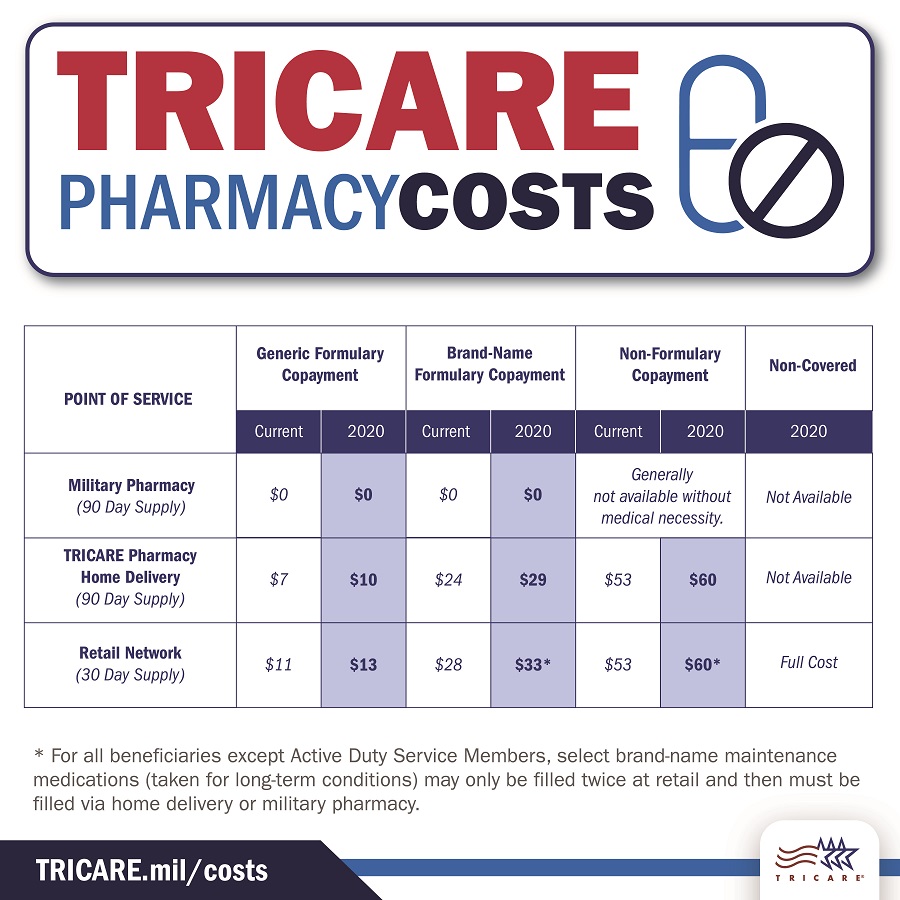
Tricare Pharmacy CoPayments Change in 2020

If you’ve filled a prescription this year, you might have noticed that the price jumped up a bit compared to 2019. That’s because it has.

Effective January 1, Tricare updated its copay cost-share for beneficiaries. Here’s the breakdown:

  • Military Treatment Facility (MTF): no changes to current plan
  • All Active Duty Service Members: no cost at MTF or network pharmacies

Tricare Pharmacy Home Delivery: 90 day supply

  • Generic Formulary: 2019 rate – $7; 2020 rate – $10
  • Brand-Name Formulary: 2019 rate – $24; 2020 rate – $29
  • Non-Formulary: 2019 rate – $53; 2020 rate – $60
  • Non-Covered: not available

Retail Pharmacy: 30 day supply

  • Generic Formulary: 2019 rate – $11; 2020 rate – $13
  • Brand-Name Formulary*: 2019 rate – $28; 2020 rate – $33
  • Non-Formulary*: 2019 rate – $53; 2020 rate – $60
  • Non-Covered: full cost

*Note: brand-name and non-formulary prescriptions can only be filled twice via retail network pharmacies; following this they must be filled at an MTF or via Tricare Pharmacy Home Delivery.

Make Early Breast Cancer Detection Easier with New Covered Screening

Starting January 1, Tricare has expanded access to preventative breast cancer screening measures to more female beneficiaries. More women can now be screened for breast cancer with an annual 3D mammogram.

Previously, this option was only available for patients deemed “at risk.” All other patients received a 2D mammogram by default.

This change comes in response to ongoing research and data about breast cancer from the American Cancer Society. Currently, 1 in 10 American women will be diagnosed with breast cancer in her lifetime. This makes it the second most prevalent cancer among women, coming after skin cancers.

While coverage has expanded significantly, 3D mammograms will not be standard practice for every female Tricare beneficiary.

In order to receive a 3D mammogram, you must meet one of the following criteria:

  • Age 40 or older
  • Age 30 or older with high-risk factors; have a 15% or greater likelihood of breast cancer occurring

This new cancer screening option is covered under the Provisional Coverage Program. This Tricare program covers the cost of certain new or developing medical procedures and medications as part of a clinical trial or study.

Tricare can extend the coverage of this option for up to 5 years. At that time, Tricare will review their data to determine if the program should become a covered benefit.

More Provisional Coverage Programs You Should Know

It’s not just 3D mammograms that are being covered by the PCP. There is also a new treatment for osteoarthritis of the knee and tennis elbow being piloted.

If you have a diagnosis of mild to moderate chronic osteoarthritis of the knee or lateral epicondylitis, also known as “tennis elbow,” you might qualify for this new treatment.

Speak to your PCM to discuss treatment options if you meet the above criteria.

Picking a Tricare Plan for Your Family

When considering changing your Tricare plan(s), there are a few things you should be aware of:

  • Changes can typically only be made during open enrollment season, which typically falls between October and November
  • Changes can also be made for a qualifying life event, such as retiring, PCSing, marriage or adding a child to your family

Before committing to a Tricare plan, it is advised that you consider their plan comparison tool. This helps beneficiaries better understand out of pocket costs, if any, as well as where they can access care.

Beneficiaries can also use an interactive Tricare Plan Finder. This online quiz determines your current benefit status and healthcare needs, as well as plans available in your current location.

It is important that you understand all the different programs and options for care available to you in order to make an informed decision about your health.

What else could or should change to make Tricare a better health care plan for active duty, reserve or retired troops and families? Sound off in the comments!

Ways to Connect Without Tech: Old Fashioned Care Package and Letter Ideas

01/15/2020 By Meg Flanagan

As rapid response units have deployed, and more stand ready in the wings, many families are facing a deployment reality that has become uncommon in the last few years. These troops are being sent to the front without their smart devices. Leaving families to rediscover fun ways to connect without tech.

Ways to Connect Without Tech: Old Fashioned Care Package and Letter Ideas

Even just as recently as the start of the conflicts in Iraq and Afghanistan, many military families exclusively relied on the time-honored traditions of letters and care packages to stay connected during deployments. As technology has developed over the last 20 years, more forward-deployed troops have been able to access the internet, social media platforms or even bring their smart devices with them.

This meant that families no long had to wait for a patchy satellite phone call to come through as their only means of communication in weeks. Instead, emails can be sent or video chats can be started at the drop of a hat. Or, you know, as the mission, internet connectivity and time differences allow.

But with some recently deployed units being told to leave all tech at home, many families will need to dust off their old standbys for connection and communication. Do you remember how to write a meaningful letter or stuff a care package?

Write Letters They’ll Remember

It’s time to recall everything your middle school teachers told you about writing letters. Except this time, make them more personal and, well, loving!

If your loved one is deployed without regular internet access or mail service, Jo, My Gosh recommends making a bunch of “open when” letters.

These are essentially letters that you ship off with your spouse or loved one, packed into their seabag or backpack. Each letter is labeled with a time or situation for them to open that one letter. Things like:

  • you feel sore
  • you wish you could watch the big game
  • you feel hopeless
  • you miss me
  • you had a great day

Each themed letter should include encouragement about that particular situation. Jo also recommends including a small gift, like a picture of you together or a pain relief patch, with the letters.

This option works great for troops deployed on ships or in combat zones. You could send some letters with your loved one now, and then plan a second (or third) wave of open when letters in a few weeks.

If you will have semi-regular mail services, you can write more often and talk about current events! Share news from your life, what your kids (or pets) are doing and other points of interest.

ArmyWife 101 writer Jackie Toops shared a poignant draft of her first letter to her newly deployed spouse, circa 2017. In it, she writes about how much she misses him and how things have changed on the home front since he shipped out. While she was sentimental, she was also upbeat and positive.

You’ll need to develop your own style for writing letters to your deployed spouse or loved one. Keep things real while also boosting morale. It’s a delicate balance to achieve, but you can do it!

Send Valuable Care Packages

It’s super tempting to load your spouse or loved one up with all the things, via care package. But it’s also important to have a reality check about what they truly need, things that might be nice to have and items that should 100% be saved for homecoming. Veterans United has a great guide that breaks everything down quickly and easily.

So, on the list of items to keep for later:

  • risque photos of yourself (or someone else) because those packages might be searched en route
  • drugs or alcohol
  • pork products (in some observant Muslim countries or locations)
  • perishables
  • valuables like jewelry, cash or technology
  • weapons, including guns
  • aerosols or pressurized products

Things that are nice to have, but maybe not always needed could include:

  • candy and other snacks
  • leisure activities, like decks of cards or travel-sized board games
  • books or magazines
  • word games, like crosswords
  • easy-to-pack sports equipment, like a baseball and glove

Consider packing these items more often:

  • deodorant
  • baby powder
  • topical pain ointment
  • lotion
  • sunscreen
  • high-protein snacks
  • water flavor packets
  • soap
  • baby wipes
  • socks
  • hand sanitizer
  • tampons and pads

Of course, not every service member wants or needs the same things. Try to tailor your care packages to what your spouse or loved one needs and/or enjoys.

Rachel at Countdowns & Cupcakes has hundreds of ideas for themed care packages to make year-round! From branch-specific ideas to coffee themes or celebrating the holidays, she has a care package for every occasion and then some!

Make Sure You Send Letters & Packages Securely

When you’re sending mail to troops deployed overseas, it’s important to know the rules about how to send all the things.

First, make sure you get their forward-deployed address. It’s usually their name, including rank, then a line that substitutes for the street address. Following that is FPO, APO or DPO plus their region code. Right now, that region code is probably AE (Middle East) or AP (Asia-Pacific). There will also be a 5 to 9 digit zip code.

Label the envelope or package as normal:

  1. Name
  2. “Street” address – it’s the second part of the address your loved one shares
  3. FPO/APO/DPO, AP “Zip Code” – that’s the 5-9 digit code that comes last

If you are sending a letter, stick a stamp on there and you’re done! Sending mail to APO/FPO/DPO addresses costs the same as sending something from MA to CA.

It’s wise to stock up on forever stamps in advance, that way you can write letters whenever and just drop them in the mail without a trip to the post office.

For packages, the rules are a little different. You’re going to need a customs form. There are two kinds:

  • long
  • short

The long form is, well, longer. It’s larger and you’ll need to share more info about what’s in the package, who it’s going to, etc. The short form requires just the basics: a brief description of contents, a general estimate of value, and who it’s going to as well as coming from.

Every single package needs this form. Yes, even if you are sending multiple packages to the same address on the same day. Every single individual package gets a customs form.

When packing your care packages, you’ll want to be careful. The best advice: use lots of tape to really secure everything. Cover every edge, corner and seam with 1-2 layers of packing tape.

Pack delicate or fragile things inside of cushioning, like socks, to prevent breakage.

Try to avoid shipping liquids, but if you must, it’s best to seal them inside of plastic bags to prevent leaks.

Strong smelling items should not be placed with food. Your beef jerky won’t be as delicious if it smells like laundry powder or icy-hot cream.

What are your best tips to make letters and care packages to deployed troops valuable or special? Sound off in the comments!

« Previous Page
Next Page »
  • OIOpublisher.com

Featured This Week

SIGN UP FOR MILITARY COUPONS & SAVINGS!

Search the site:

Get Social With Us!

FAQ’s

  • Privacy Policy
  • Contest Rules
  • Terms of Use

Community

  • Base Reviews
  • Inspirations

About Military Life News

  • Contact Headquarters
  • Advertising

Copyright © 2025 · Magazine Pro Theme on Genesis Framework · WordPress · Log in